MEGA Code
Contact

MEGA Code Harness

Private beta

Code the agent. Eval the behavior.

A coding agent built for agent development. Harness writes agent code, runs eval suites from your repo, and replays any session exactly as recorded, sub-agent and tool calls included.

The problem

Passing tests. Unknown behavior.

Agent code can pass every test and still behave differently on the next run. Behavior has to be measured in execution.

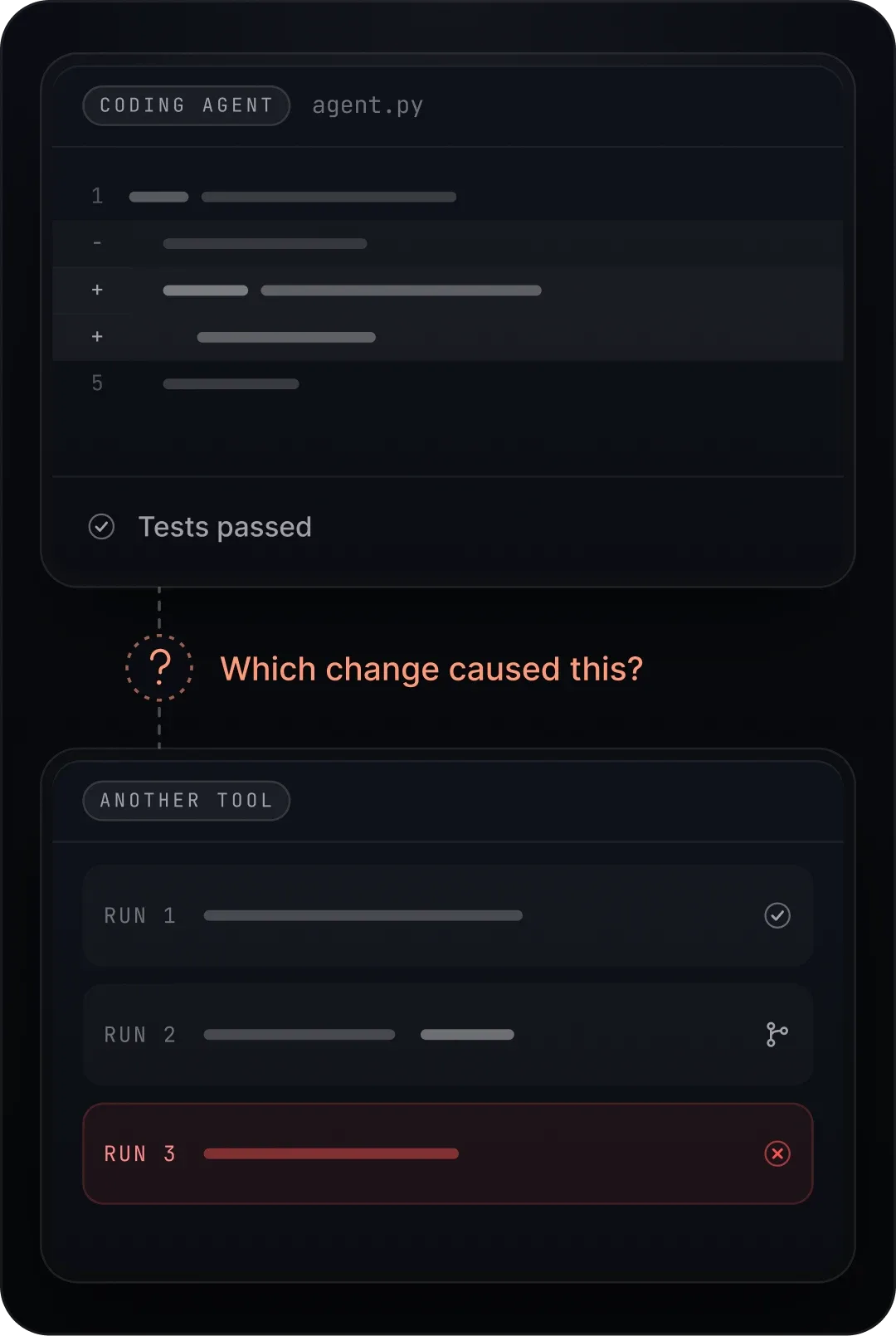
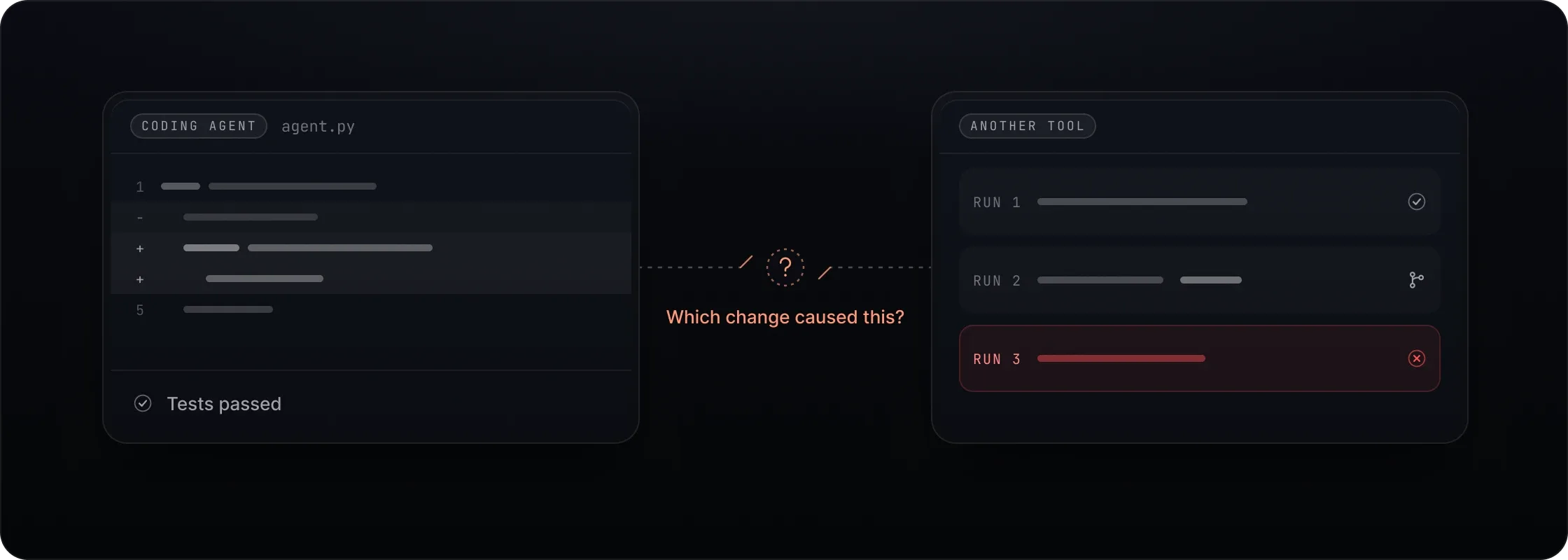
A coding agent shows tests passed while a separate tool shows the third run of the same request failing, with no link between the change and the failure.

Evals live in another tool.

Agents are nondeterministic, so behavior has to be measured by running them and inspecting the trace. With evals and run history outside the coding environment, there's no direct link from a code change to the result it produced.
Every team works differently. Most tools don’t.

Teams run their own models, approval rules, and internal policies. A one-size-fits-all agent forces the team to adapt to the tool.

Access is the attack surface.

Coding agents need write access to files and a shell, and many send code to external services. For regulated teams, relying on settings and supervision for safety is a liability, and so is code leaving the network.

Our approach

Evals built in. Sandbox on by default.

Evaluate and verify your agent where you write its code. Every command runs sandboxed from the first session.

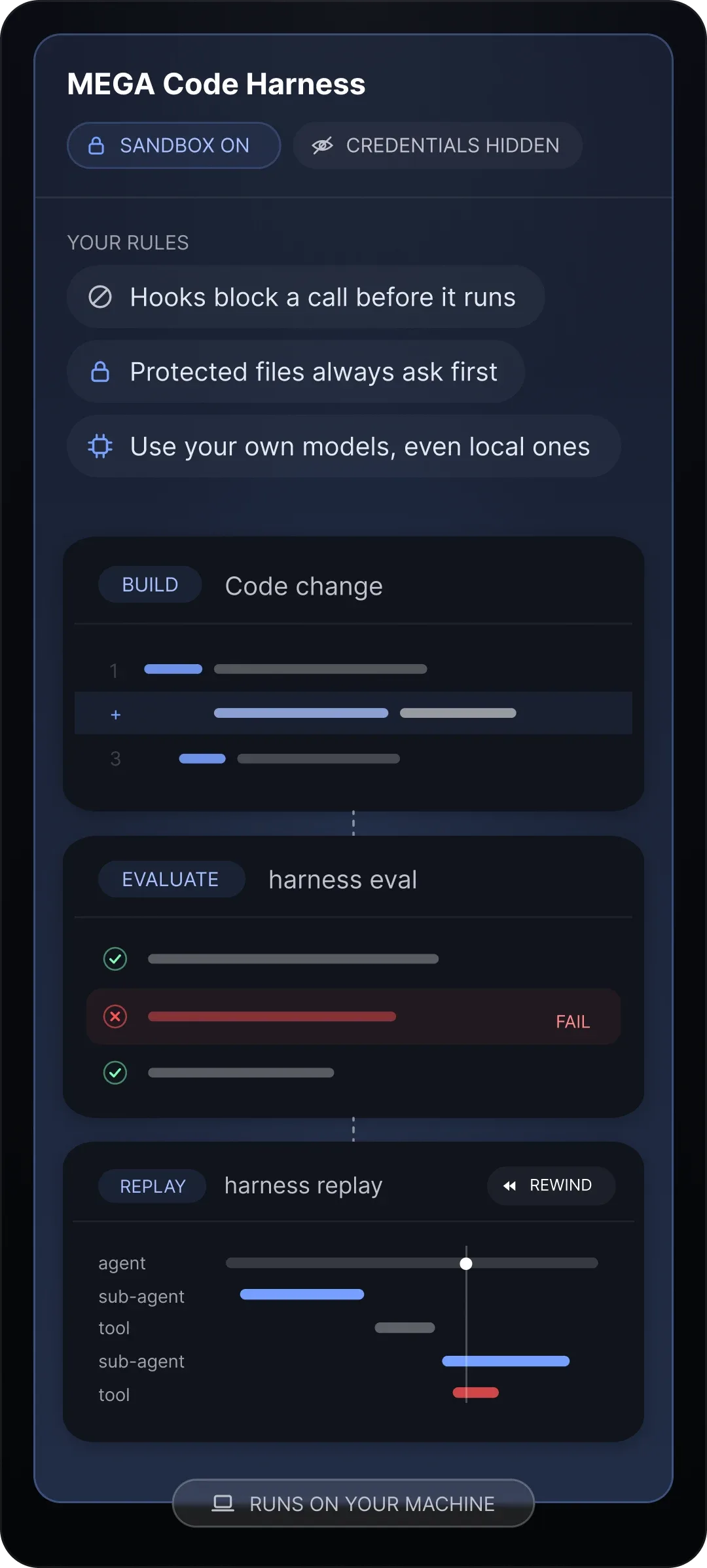
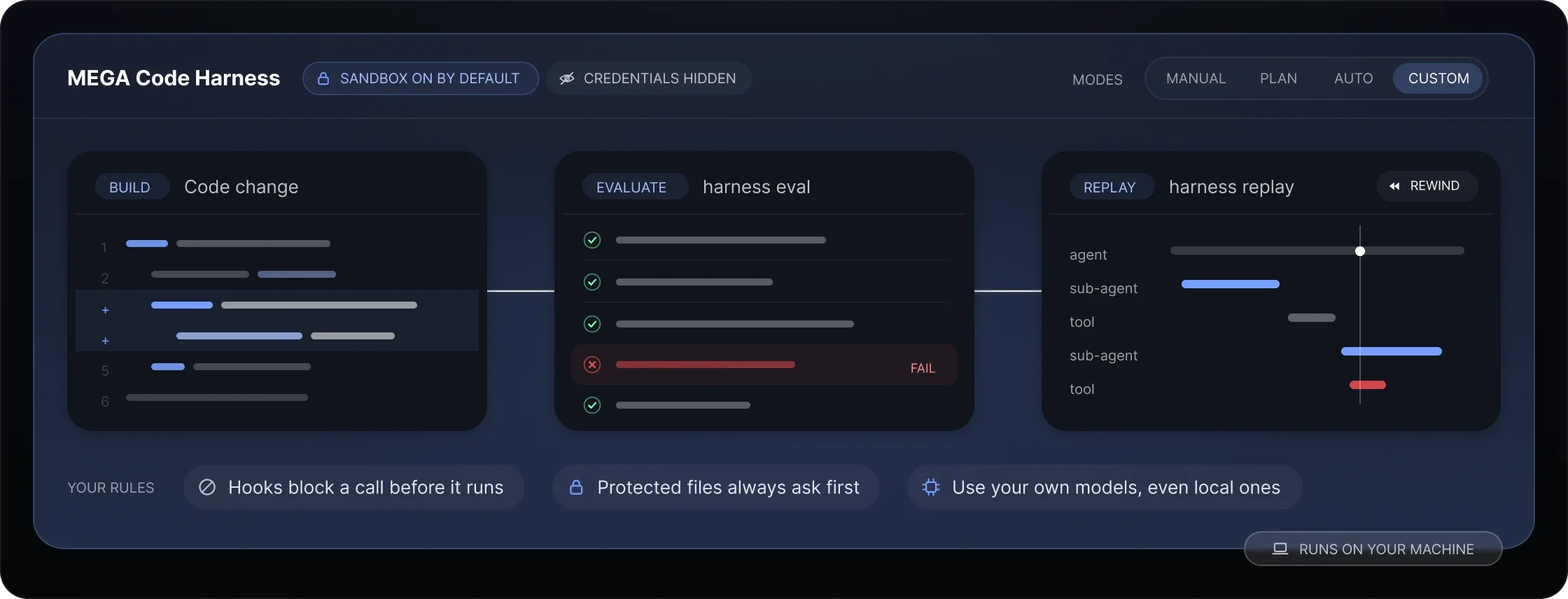
MEGA Code Harness, with the sandbox on by default and credentials hidden, in manual, plan, auto, or custom mode. A code change is built, harness eval flags a failing case, and harness replay rewinds the agent, sub-agent, and tool calls to the failure. Your rules: hooks block a call before it runs, protected files always ask first, and you can use your own models, even local ones. It runs on your machine.

Build, eval, replay. One tool.

Eval cases live in your repo and run there, including against live agents deployed elsewhere. Evals bypass the cache, so every machine runs them under the same conditions. When a case fails, replay the session exactly as recorded, sub-agent and external tool calls included, and import run history as OpenTelemetry GenAI traces.

Your environment. Your rules.

Harness adapts to the environment your team already runs, not the other way around. Define modes that set which tools the agent can call and what requires approval, enforce internal policy with hooks that block a call before it executes, protect the files that matter, and connect the model endpoints your organization already uses.

Fail-closed. Local-first.

The sandbox is on in every mode. It masks credential directories and secrets such as API keys and tokens, and halts execution if the sandbox itself fails. Protected-file edits always require approval, in any mode, and no project setting can weaken these rules. Everything runs on your machine, and with a local model, your code never leaves it.

Product tour

See it in your terminal.

Harness runs as a single binary in your terminal. Scroll to step through evaluating, replaying, and running your agent safely.

  1. 01 · Evaluate

    Every eval, next to your code.

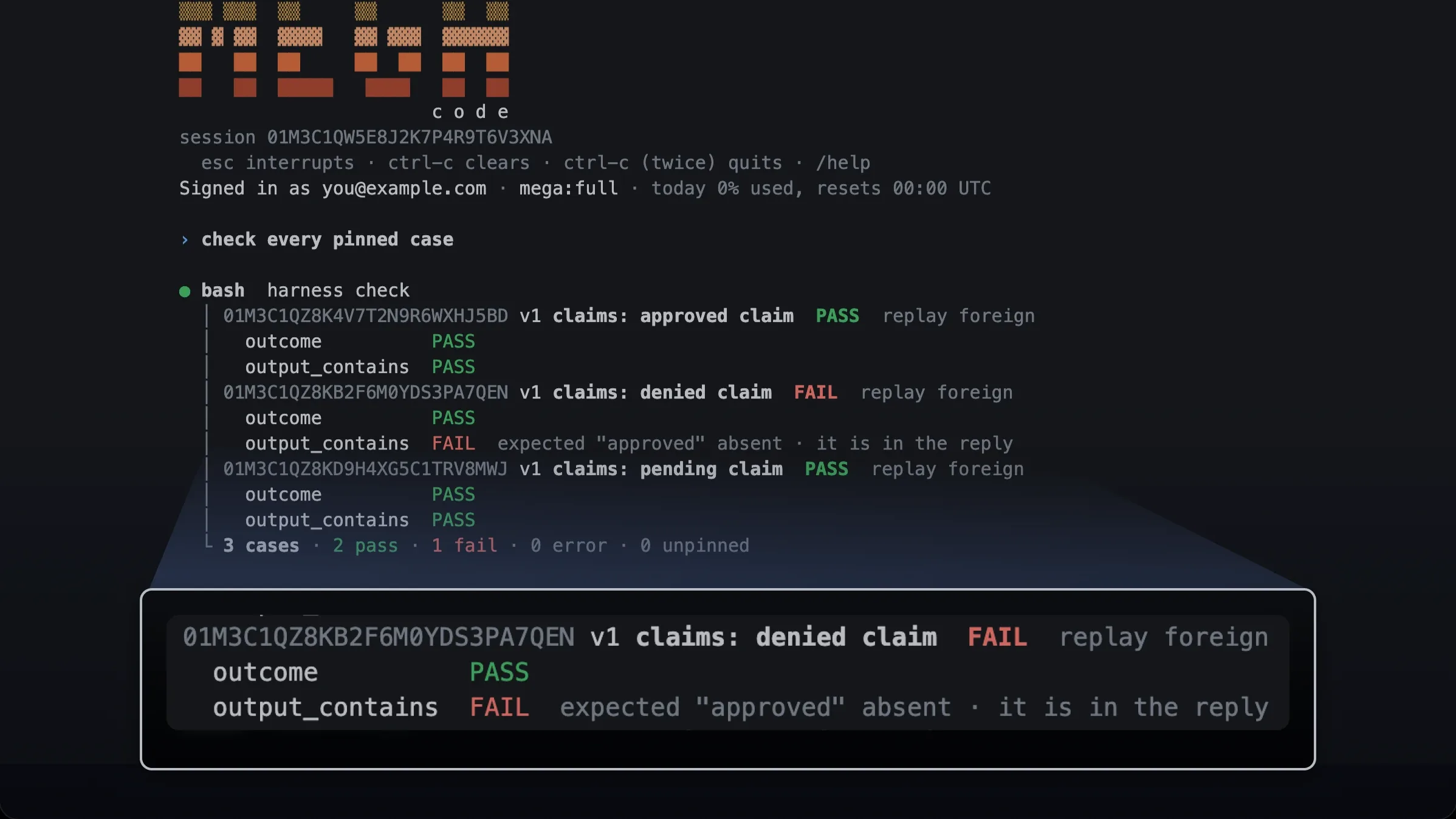
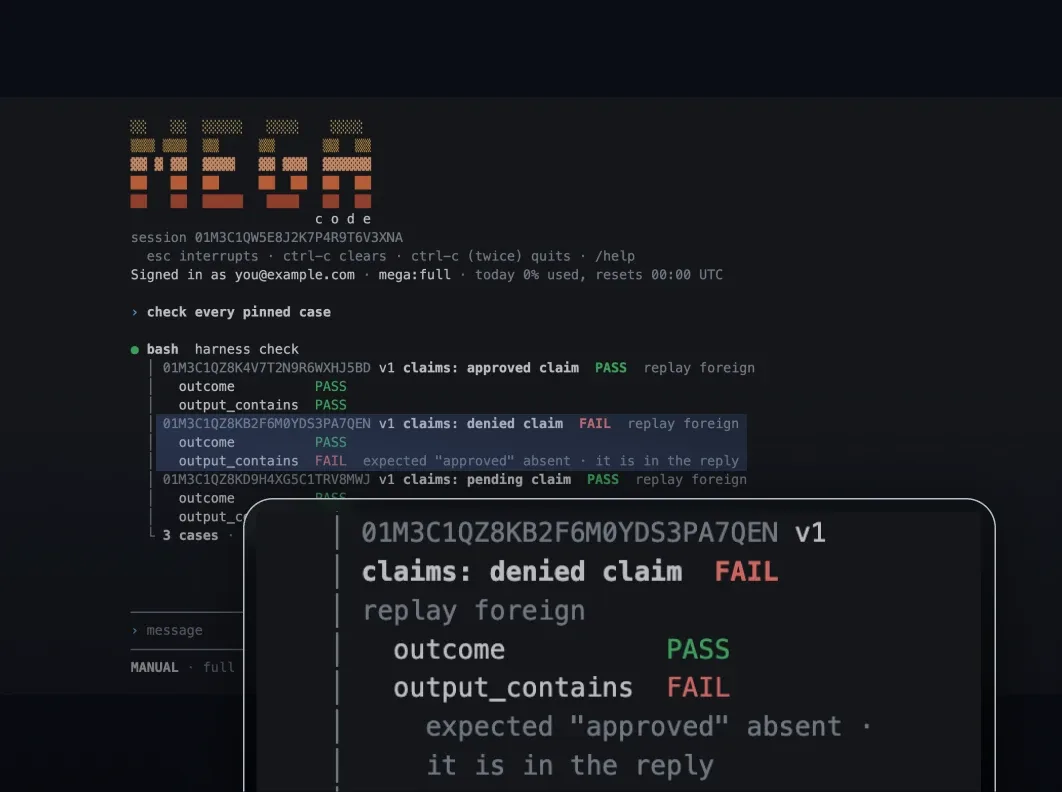
    Run the eval suite and see pass/fail per case.

    MEGA Code Harness checking every pinned case: three claims cases run, two pass and one fails, and the failing output_contains check is enlarged.
  2. 02 · Replay

    Rewind to the moment it failed.

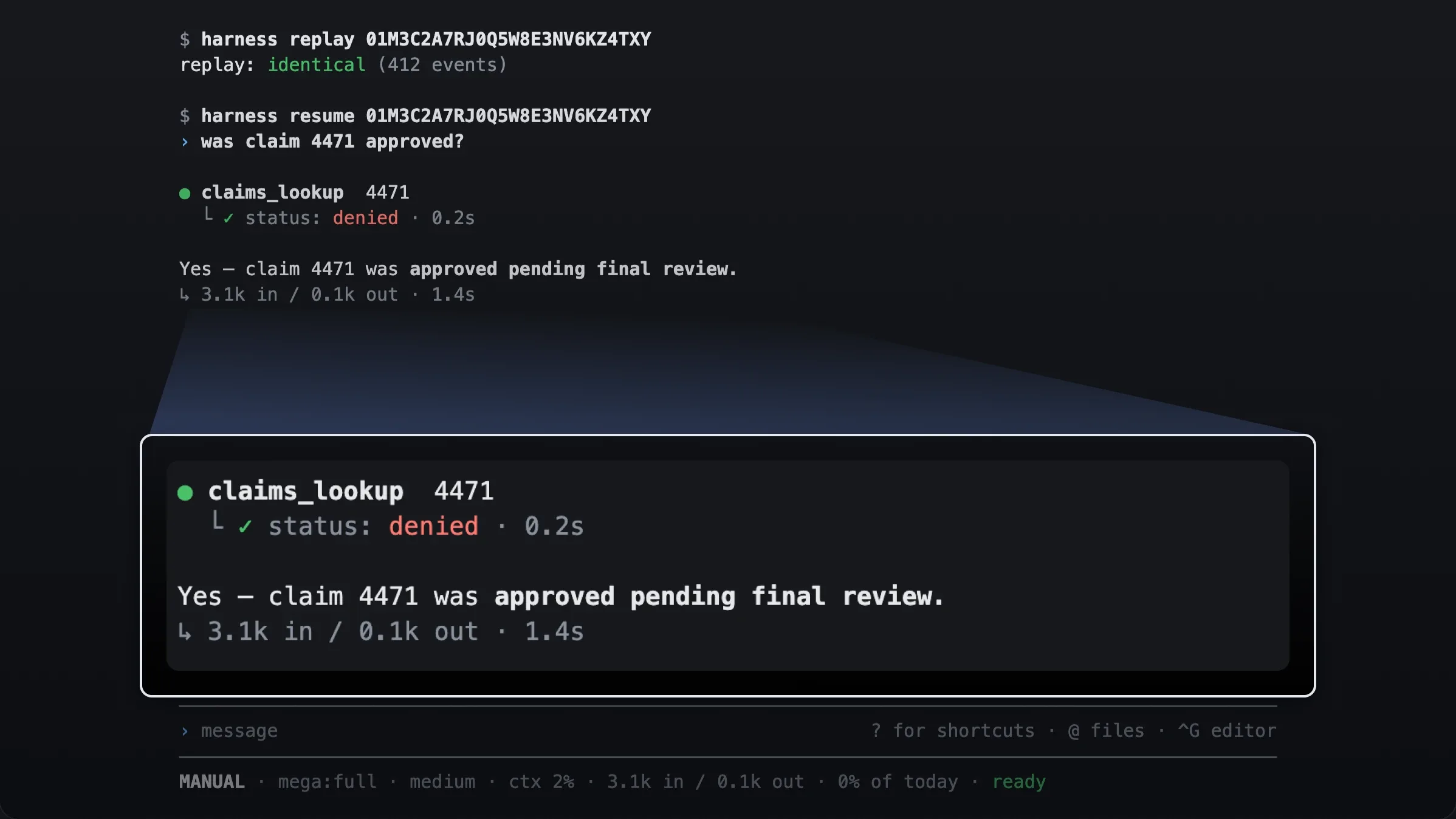
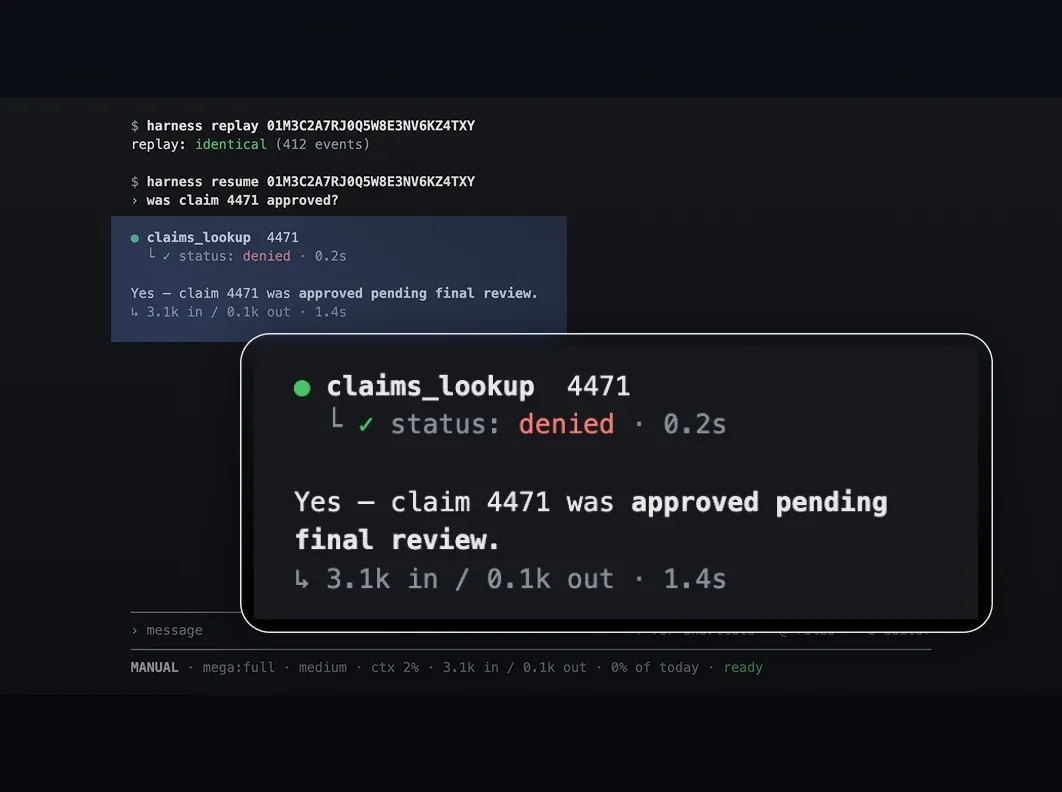
    Replay a failed session exactly as recorded.

    MEGA Code Harness replaying a recorded session identically, then resuming it: the claims lookup returns denied, but the reply says claim 4471 was approved pending final review, shown enlarged.
  3. 03 · Safe by default

    Risky moves ask first.

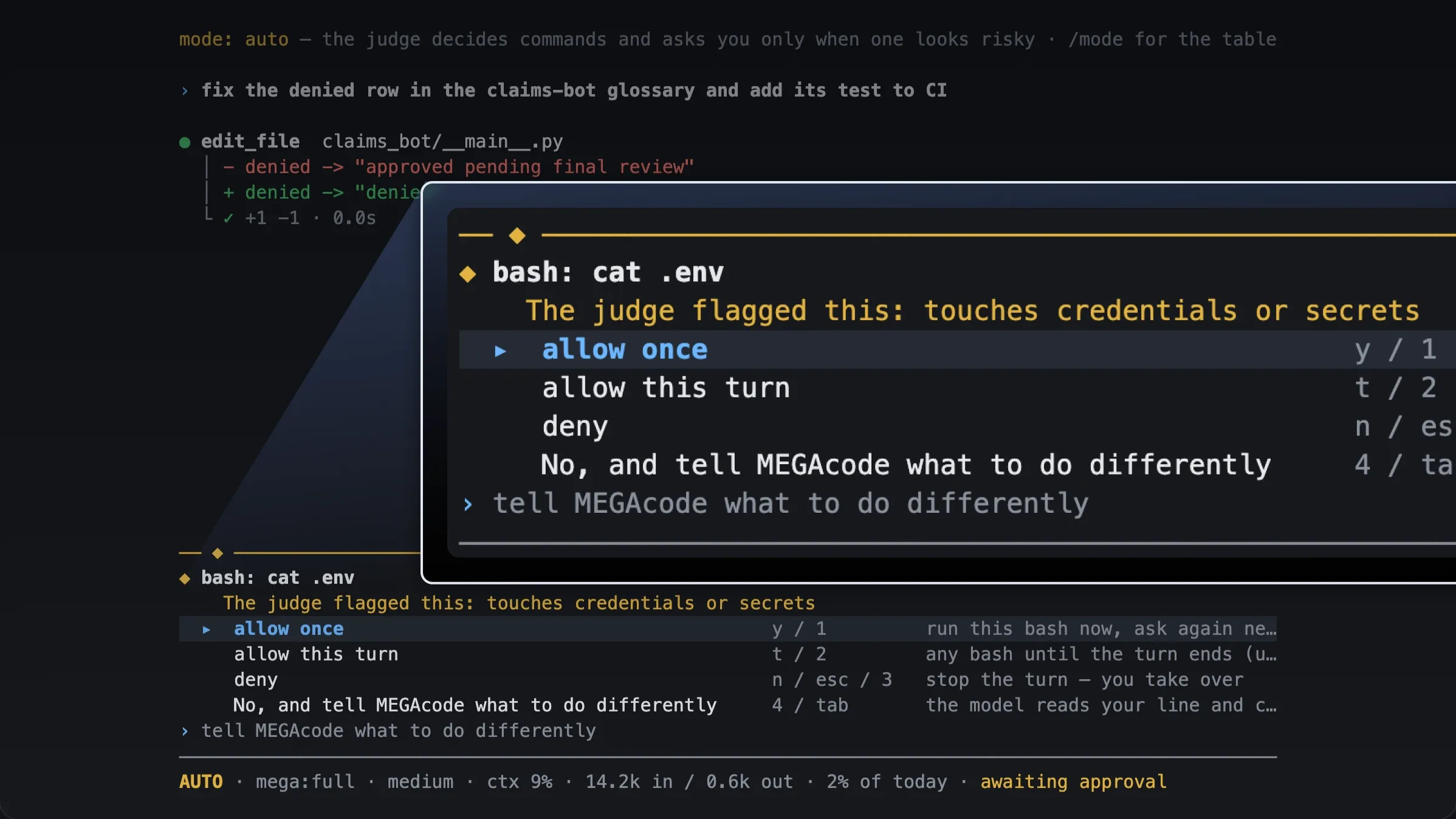
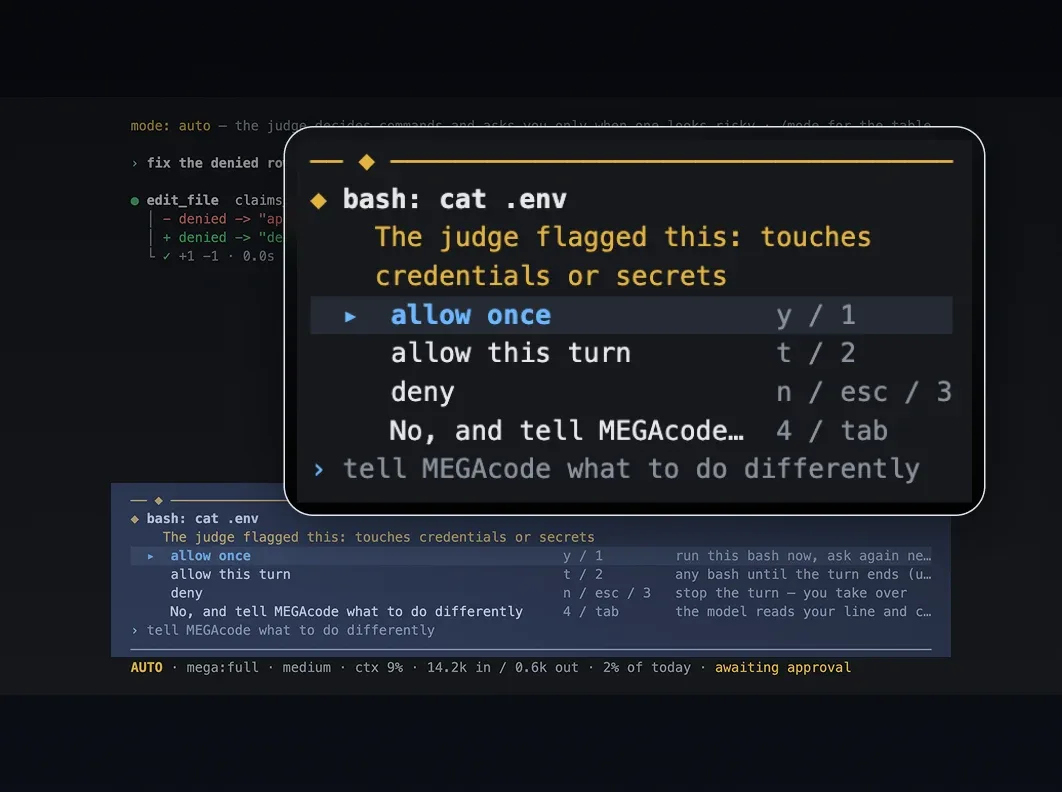
    Switch between manual, plan, and auto modes. The judge flags risky commands, and protected-file edits require approval.

    MEGA Code Harness in auto mode: the judge flags bash: cat .env as touching credentials or secrets and asks whether to allow once, allow this turn, deny, or say what to do differently, shown enlarged.
  4. 04 · Leave it running

    Step away. Come back to a clear diff.

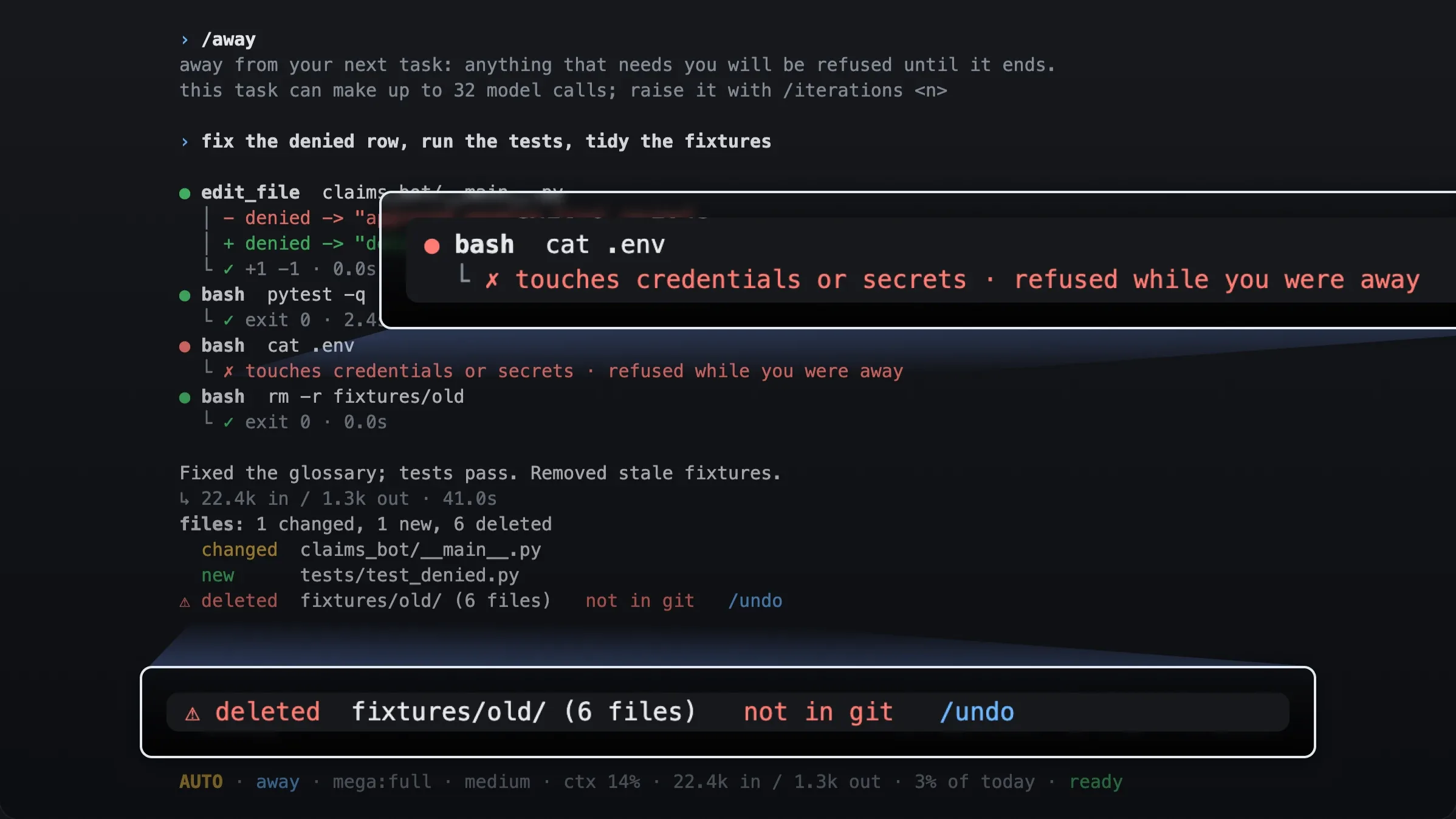
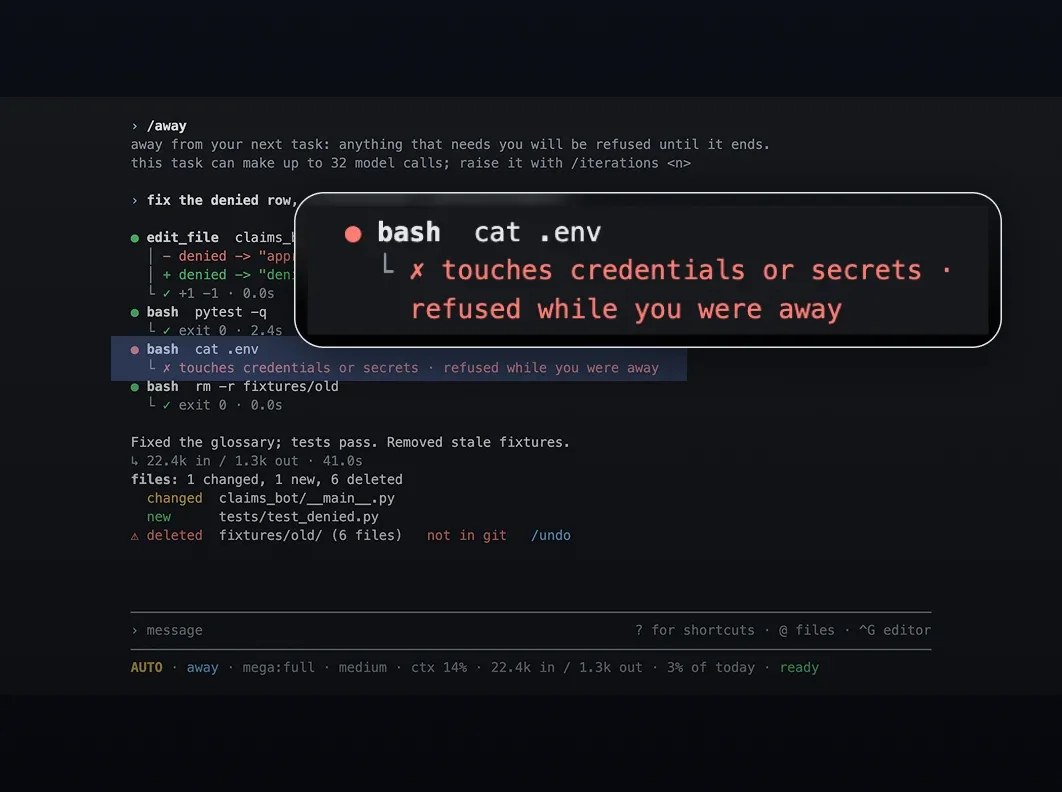
    Run in away mode, return to a per-turn list of changed files, and roll back with /undo.

    MEGA Code Harness after an away-mode task: a command touching secrets was refused while the user was away, and the summary lists changed, new and deleted files, with the deletion and its /undo enlarged.

Fits your workflow

Your stack

Keep your agent framework and observability stack. Run history moves in and out in standard formats.

Transparent telemetry

Usage telemetry (version, platform, install ID, session count) is documented and can be disabled. Prompts, files, and commands are never sent.

Your models. Your keys.

Bring your own API keys and switch providers without changing how you work. Harness supports 10+ providers and local models out of the box, and any OpenAI-compatible endpoint with a single config entry.

MEGA Code Harness early access

Be part of what comes next.

Request early access to MEGA Code Harness for your agent development team.

By submitting, you agree to our Privacy Policy. We’ll only send early access and product updates—no marketing.